Banking, Power, Metals and Q1 Results Drive Market Focus

Banking Capital Plans and Strong Q1 Results Put Financials in Focus
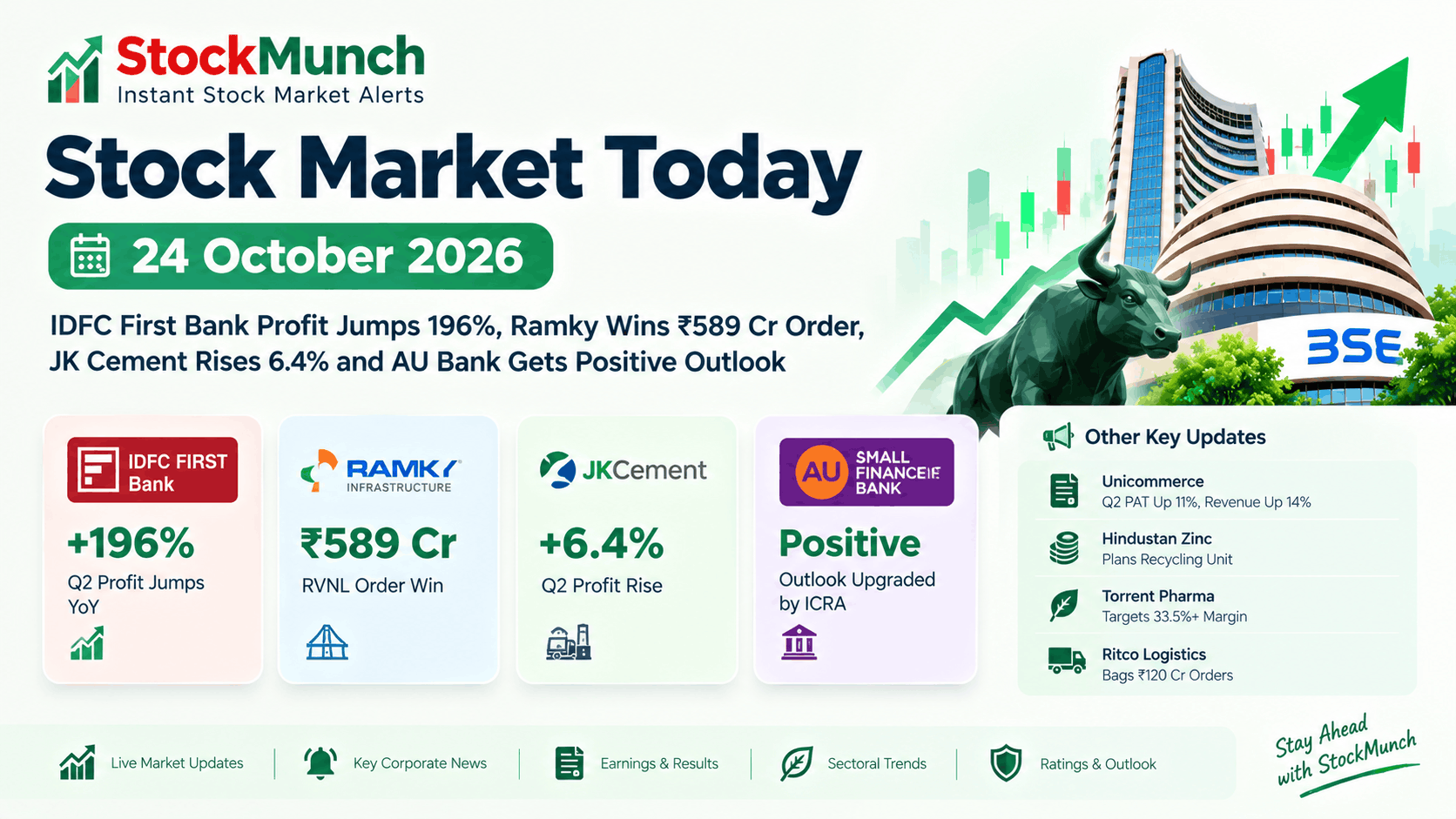
Positive impact: The banking sector delivered several important developments, led by IDFC First Bank's approval to raise up to Rs 20,000 crore and its Q1 net profit of Rs 1,075 crore, with GNPA at 1.51%. AU Small Finance Bank also reported a 37% year-on-year increase in Q1 profit to Rs 796 crore, supported by 32% growth in net interest income, while its GNPA improved to 2.1%. The combination of fundraising capacity, earnings growth and asset-quality improvement makes financials one of the most important themes in the feed.
- Market impact: IDFC First Bank's proposed capital raise could strengthen its ability to support future growth, while the Q1 performance may improve sentiment around the stock. AU SFB's profit and asset-quality trends could support sentiment across small finance banks. The developments are more directly relevant to banking and financial-sector indices than to the Nifty or Sensex as a whole, although strong large and mid-cap financial performance can influence broader market sentiment.
- What to watch: Investors will monitor the final structure and pricing of IDFC First Bank's fundraising, capital deployment, loan growth and asset-quality trends, along with whether AU SFB can sustain earnings growth and improvements in GNPA.
Power and Infrastructure Expansion Signals a Major Capital Spending Theme
Positive impact: Adani Power plans to reach 45 GW of capacity by 2032 and invest Rs 2 lakh crore in capital expenditure through cash flow, while NTPC plans to raise Rs 12,000 crore for renewable projects and has reached 90,904 MW of capacity. These announcements represent two significant developments in the power and energy investment theme. The scale of the planned spending makes the developments relevant beyond individual stocks, particularly for power generation, renewables and infrastructure-linked companies.
- Market impact: The announcements could support sentiment in power and infrastructure stocks and may increase investor focus on companies positioned around capacity expansion and renewable investment. The impact on the Nifty and Sensex would depend on the broader market response to large-cap energy stocks, while mid-cap and small-cap power and infrastructure companies could benefit from increased attention to sector growth opportunities.
- What to watch: Investors will monitor the pace of capacity additions, funding requirements, execution of planned capital expenditure and the extent to which renewable investments translate into operational growth.
Hindustan Zinc Combines Strong Q1 Profit Growth with Rs 5,000 Crore Capex Plan
Positive impact: Hindustan Zinc reported that Q1 profit doubled and announced a Rs 5,000 crore capital expenditure plan for FY27 focused on brownfield expansion. The company is also set to have Amarendu Prakash as its new CEO from August 1. The combination of strong earnings and a sizeable expansion programme makes this one of the more significant metals-sector developments in the feed.
- Market impact: The earnings performance could support the individual stock, while the capex plan may reinforce sentiment toward metals and mining companies with expansion plans. The direct effect on broader indices is likely to be more limited than that of major banking or energy developments, but the news could contribute to positive sentiment in the large-cap metals space and related mid-cap companies.
- What to watch: Investors will monitor the execution of the brownfield expansion, future earnings performance, commodity-market conditions and the transition to the new CEO.
Adani Energy Solutions Beats Estimates as Revenue Growth Outlook Remains Strong
Positive impact: Adani Energy Solutions reported a Q1 performance that beat estimates, with revenue growth forecast at 54%. The combination of an earnings beat and a strong growth outlook makes the update relevant for the power transmission and energy infrastructure segment.
- Market impact: The development could support the stock and improve sentiment across energy infrastructure companies. Given the company's market relevance, a sustained positive reaction could also contribute to broader large-cap market sentiment, although the effect on the Nifty and Sensex would depend on the stock's overall market weighting and subsequent price movement.
- What to watch: Investors will monitor whether the forecast growth is delivered, the quality of earnings growth and the performance of the company's underlying businesses in subsequent quarters.
Bank of Baroda Settles NMC Case While Targeting Credit Growth
Mixed impact: Bank of Baroda confirmed settlement of the NMC case and its CEO reaffirmed the bank's legal stance. Separately, the bank is targeting 12% to 14% credit growth and aims for $4 billion in FCNR deposits by year-end. The news combines the resolution of a legal matter with an ambitious growth target, making it an important development for the bank and the broader public-sector banking narrative.
- Market impact: The settlement could reduce uncertainty around the specific legal matter, while the credit-growth and deposit targets could support sentiment if achieved. The development may influence public-sector banking sentiment and could have a broader sector impact alongside the other banking updates in the feed.
- What to watch: Investors will monitor the financial implications of the settlement, deposit mobilisation, credit growth and the bank's ability to meet its stated targets.
Strong Q1 Earnings Create a Broad but Uneven Earnings Picture
Positive impact: Several companies reported significant earnings growth. Prudent Corporate's Q1 profit rose 44% year on year to Rs 747 million, Share India reported a 47% profit increase, Arihant Capital reported a 69% profit increase with revenue up 53%, and Sakar's profit doubled to Rs 10.3 crore with revenue up 38% on oncology growth. FCS Software reported a 6,200% increase in Q1 profit and an 83% rise in sales, although the scale and sustainability of such a sharp percentage increase require close scrutiny.
- Market impact: The results could support individual stocks and improve sentiment in financial services, capital-market businesses, healthcare and smaller technology companies. Strong earnings from mid-cap and small-cap companies can increase stock-specific activity, but the broader market impact is likely to remain selective rather than uniform.
- What to watch: Investors will monitor the quality and sustainability of earnings growth, revenue momentum, margins and whether the reported performance reflects recurring business improvement.
IT Earnings Remain Mixed as MosChip Reports a Sharp Q1 Decline
Negative impact: MosChip reported a 13% decline in revenue and a 78% fall in net income in Q1. The weak result stands in contrast to the broader focus on IT earnings, with TCS and Infosys leading the sector's Q1 report card in the feed. The MosChip result is therefore an important negative signal for the company and a reminder that performance across the technology sector remains uneven.
- Market impact: The sharp profit decline could weigh on MosChip and may increase volatility among smaller IT and semiconductor-related stocks. The direct impact on the Nifty and Sensex is limited, but the result could affect sentiment in the small-cap technology segment.
- What to watch: Investors will monitor whether revenue weakness stabilises, whether profitability recovers and whether management provides evidence of a return to growth.
Financial Services Continue to Show Strong Growth, but Credit Risk Remains a Key Monitor
Mixed impact: Five-Star Finance reported Q1 disbursements up 23% quarter on quarter with PAT at Rs 2,714 million, while CreditAccess reported its Q1 earnings and Suryoday Bank's advances rose 32.5% year on year to Rs 14,376 crore. However, Suryoday's GNPA stood at 6.5%, highlighting that strong growth in lending can coexist with asset-quality concerns. The combination makes the non-bank and small-finance segment an important area for selective analysis.
- Market impact: Strong disbursement and advances growth could support sentiment for the relevant stocks and the broader financial-services sector. The elevated GNPA figure at Suryoday could temper enthusiasm and increase differentiation between lenders. The developments are more likely to influence mid-cap and small-cap financial stocks than the major market indices.
- What to watch: Investors will monitor asset quality, credit costs, collection performance, disbursement growth and whether loan expansion translates into sustainable profitability.
Healthcare and Pharmaceuticals See Strategic Expansion and Regulatory Progress
Positive impact: Aurobindo Pharma signed a licensing deal with MSD for generic Alimta, adding to its oncology portfolio. Laurus Labs received NCLT clearance for its demerger plan and is targeting 50% of revenue from CDMO operations by FY30, with a stated goal of 23% ROCE. Sakar also reported strong oncology-led growth. Together, these developments create a notable healthcare and pharmaceutical theme centred on portfolio expansion, restructuring and oncology exposure.
- Market impact: The Aurobindo deal could support sentiment toward the company, while Laurus Labs' demerger clearance may reduce uncertainty around the proposed restructuring and focus investor attention on its stated CDMO strategy. The developments could support selective pharmaceutical and healthcare stocks rather than the broader indices.
- What to watch: Investors will monitor the commercial progress of the licensing arrangement, execution of the Laurus demerger and progress toward the stated revenue and return objectives.
Manufacturing and Industrial Expansion Continues Across Metals and Renewables
Positive impact: Sarda Energy approved a Rs 300 crore expansion for its Vizianagaram plant and is targeting a debt-free status by June. Swelect Energy acquired Dexler Solar for expansion in Karnataka, while ONGC started deepwater drilling in the Mahanadi Basin. Raghav Productivity secured quartz patents and aims to boost silica output, while 3i Infotech secured an ONGC Petro contract for IT and infrastructure management. The developments point to continued activity across industrial, energy and infrastructure businesses.
- Market impact: The individual companies could see stock-specific interest from expansion, contract and capacity developments. The broader impact is likely to be strongest across mid-cap and small-cap industrial, renewable-energy and infrastructure stocks, with limited direct effect on the major indices.
- What to watch: Investors will monitor project execution, order conversion, capacity utilisation, acquisition integration and the financial impact of expansion spending.
Negative and Cautionary Signals Emerge from Cement, Insurance and Industrial Operations
Negative impact: Birla Corporation reported a 3.2% decline in Q1 profit, with lower cement prices and higher costs weighing on performance, while EBITDA per tonne also declined. New India Assurance reported a Q1 loss linked to a decline in property premium. High Energy's Q1 revenue fell 43% year on year, and Tanfac's Q1 net profit declined 12.9%. Flooding also disrupted operations at Bhagwati Autocast, while Gandhar Oil is reviewing the impact of flooding at its Silvassa plant.
- Market impact: The developments create a mixed earnings backdrop and could weigh on the affected stocks. The cement result may raise concerns about pricing and cost pressures in the sector, while operational disruptions from flooding could increase uncertainty for affected industrial companies. The impact on the Nifty and Sensex is limited but may contribute to a more selective market environment.
- What to watch: Investors will monitor the recovery of affected operations, cost trends, pricing conditions, insurance-related developments and the sustainability of earnings pressure.
Market Outlook
The latest news flow presents a mixed but eventful market backdrop, with strong banking results, large power and metals expansion plans and selected pharmaceutical and industrial developments supporting sentiment. At the same time, weak results from some technology, cement, insurance and industrial companies, along with asset-quality concerns in parts of the lending sector, highlight the need for differentiation. The combination of large capital-spending announcements, earnings surprises and company-specific risks is likely to keep sector and stock-specific developments at the centre of investor attention.
Related Articles
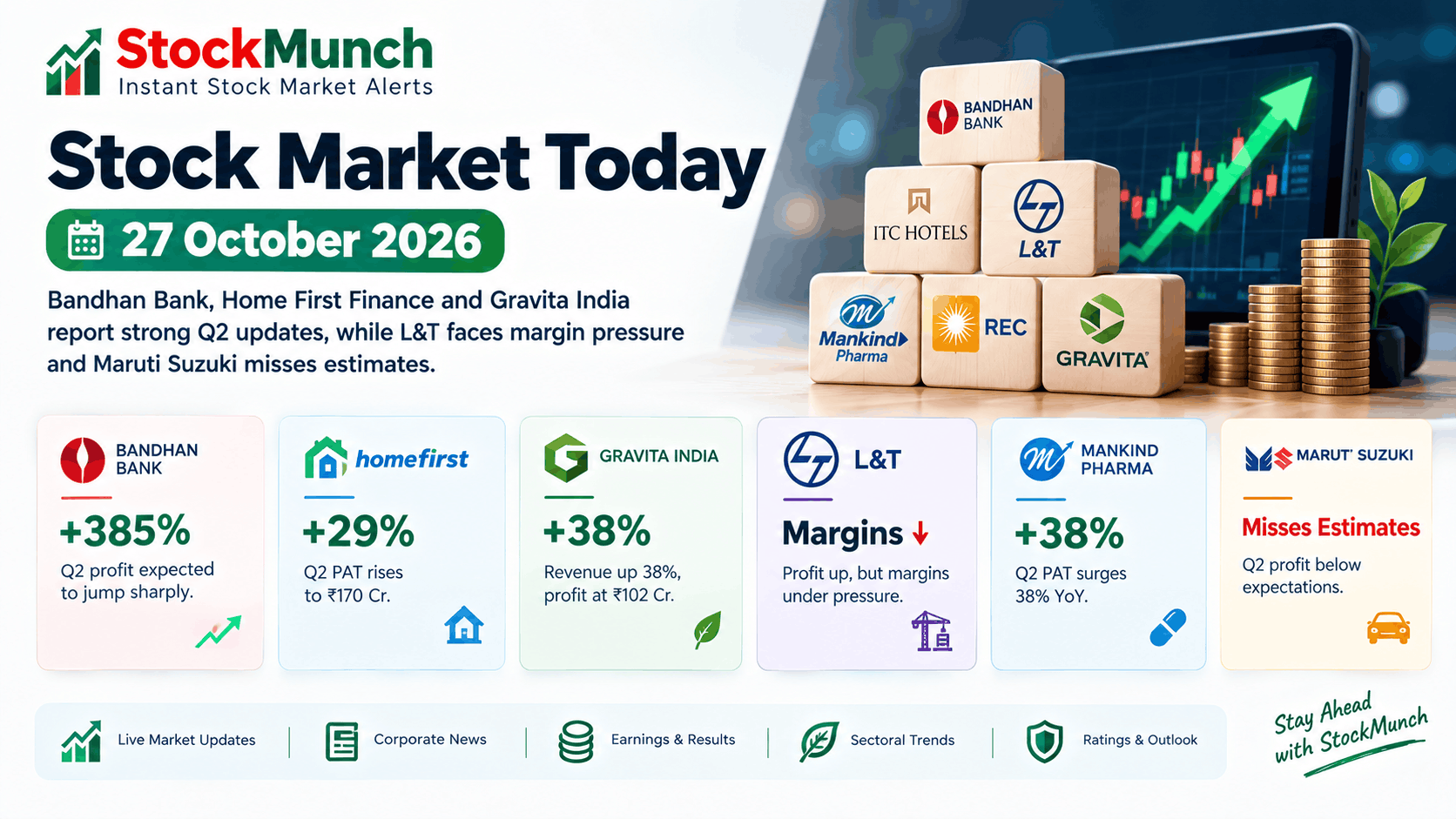
Stock Market Today (27 October 2026): Bandhan Bank, L&T, Gravita in Focus
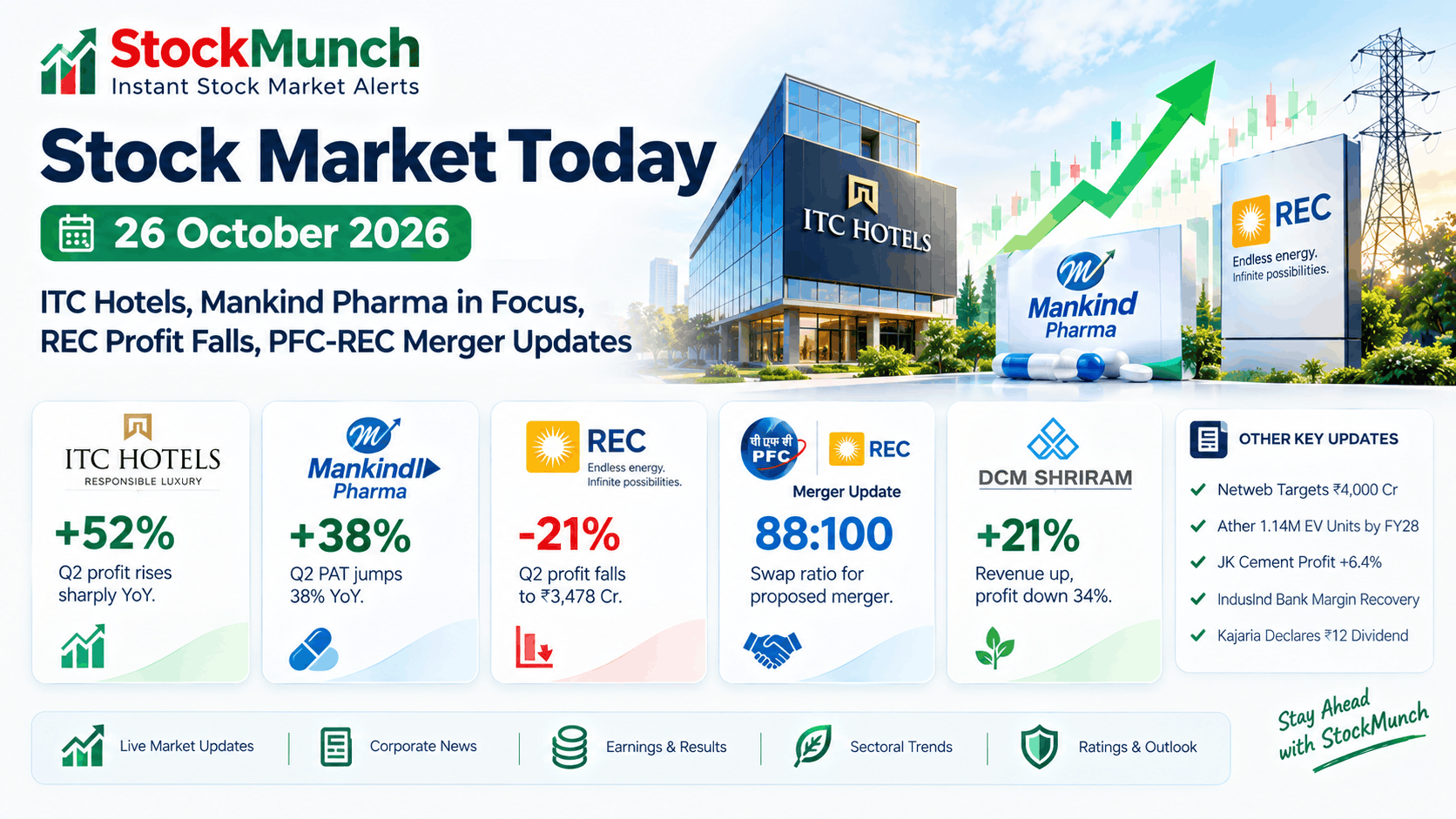
Stock Market Today (26 October 2026): ITC Hotels, REC, Mankind Pharma in Focus